Showing posts with label WDUQ. Show all posts

Thursday, October 04, 2012

Changing Planes, Changing Plans

Changes in my life mean I'm back to flying more often.  The couple of years away from frequent air travel has reminded me how much it has changed. 

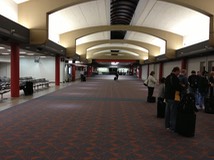
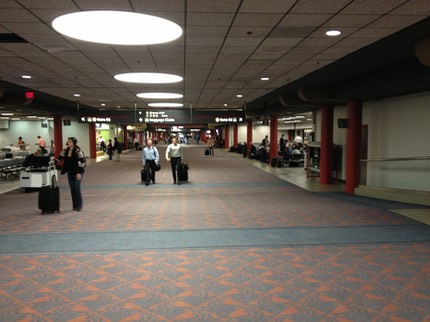
This week marks the 20th anniversary of the opening of the Midfield terminal at Pittsburgh International Airport.
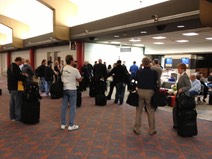
photo: Scott Hanley

Photo: Scott Hanley
Photo: Scott Hanley


The Pittsburgh Post-Gazette has a very good retrospective on the "new" airport - and how the world changed in less than a decade to make for a decidedly less ambitious current state. 

The "new" Pittsburgh International was unique in its time - I liked to call it the most secure shopping mall in America, since, before "9/11," anyone could come in and peruse the scores of shopping mall-type stores at the AirMall.  I recall buying my first sound card for a computer at PIT while on a visit with my sons.   

The walk to make connections was far easier than most airports.  The baggage claim system was "state of the art," though that art had a way of not always living up the promise...

Greater Pittsburgh International Airport, 1950's


I remember flying into the old Pittsburgh airport long before I ever thought I might live in Pittsburgh.  It was a grand old place in its own way.


NPR VISITS

In January 2001, NPR's All Things Considered sent an entire production team to Pittsburgh International to follow what went on in the course of the 24 hour workdays at what was still, then, a very busy airport.

                            
Airplanes at Pittsburgh International Airport
(Photo: Ellen Weiss)

This NPR project was more than a dozen years ago.  It is interesting to hear how much like every other airport operation PIT was back then.  It is a transit hub, so there are things that have to be done.   People working at 3 in the morning face many common issues, so this was a good, generalized set of stories. 


Still active but not so busy


Pittsburgh still has a fairly busy airport for a community of its size.  It just isn't as busy as what planners had expected. PIT appears to now be serving fewer travelers than Cleveland-Hopkins International. 

The evolution over time of Detroit Metro Airport is a good indication of what a difference the travel needs of 4 to 5 million people can do for business as opposed to a market of 1 or 2 million. With more international travel and a larger base population to originate flights from, Detroit Metro continues on a pattern of increased passenger visits.

I remember coming to the "new" Pittsburgh International not just to make a connection but for business.  But it took very sad turn with the crash of USAir flight 427 taking 132 lives in September 1994. This was less than two years after the opening of the new terminal.  This was also not long after the Pittsburgh newspaper strike of 1992-93, which changed the landscape of media in that city. 

The media coverage of crash of flight 427 was a bellwether event for a city ready to head into yet another era of change.  The much investigated accident led to changes in how all Boeing 737's would be maintained, too.

The downturn in USAirways activity, the reduced air travel from several recessions and the very nature of being in a smaller city meant that whatever USAir would or would not do in Pittsburgh would have stronger impacts on the airport than one would see in a much larger market. 


I now live in Birmingham, AL, where the Birmingham-Shuttlesworth International Airport is the largest in the state and sees about half the traffic of PIT.  

Which brings me to a topic I hadn't thought of at all when I first contemplated writing this post.  As of this week, the Birmingham News is changing, too, cutting back print editions from 7 days a week to three, and renaming the enterprise the Alabama Media group. 

My station, WBHM, and our Junior Advisors Board is holding an "Issues and Ales" event this week, bringing together media experts of different backgrounds to discuss what is next in the realm of information and journalism in transition.

Thursday, Oct. 4 from 6 to 8 p.m. at Cantina at Pepper Place in Birmingham, AL.

Hope to see you there - as we get started on the future.

John Lennon wrote, "Life is what happens while you're busy making other plans," and I tend to agree. But if you are paying attention and choose to act, perhaps you can have a role in whatever comes next.

But fasten your seat belts, put your tray in the appropriate position, and be mindful of the exits!

Friday, August 10, 2012

..they pull me back in.

I'm back.  Back to public radio.

At first, the clip from "The Godfather, Part III" came to mind:

 
As apt as that Al Pacino moment may seem in the context of going back to the realm of coffee mugs and pledge drives, my "return" is pretty exciting.

I have accepted the position of General Manager for WBHM in Birmingham, Alabama. The people and the community impress me. It reminds me a bit of Pittsburgh - and WDUQ - in 1995. A city with a legacy in steel, evolving into a center for medicine, commerce, and education. The changing media world is offering up the potential for public media to take an even larger role in convening and informing the public.  It is a great opportunity with a dedicated, talented staff in a special city with a great university, the University of Alabama at Birmingham, and a strong community of listeners and supporters. I am eager to contribute to the success of what is next.


My radio career (or, should I say, my first paid radio job) started in September 1978.  The same month and year as a TV show about the business, sort of.  WKRP.

When I started, I was still a teen. From that media job to others, like Gary Sandy's character from WKRP, I moved around the country.  When I first moved to Grand Rapids, Michigan, a colleague's family emergency pulled me into on-air TV pledge drives just a couple of weeks after my arrival.  Over the years, one radio and TV job to another, there wasn't a week when I wasn't on the air somewhere, somehow, either live or "transcribed." 

And so it went for more than three decades.  About a year and a half ago, I left not just public radio, but broadcasting as my full-time gig.  Things had changed and moving on made sense.  Things do end. Even good things.

The past year and a half has been a fascinating experience, working with new groups of great and diverse people doing interesting and valuable work.

Now, another hand has been dealt in the realm of radio.   WBHM in Birmingham.


I regret leaving the State Theatre in Uniontown before their hopes and ambitions for the 90th Anniversary Season are fully realized.  It is a great organization on the rise, with a dedicated board, staff and volunteers, serving a remarkable community with a fascinating history. I will continue to support them - and encourage you to, too!   (Season opens with the musical, Titanic - September 29, 2012 - call (724) 439-1360 to order tickets for that and many other great performances).

To my friends in Pittsburgh, Uniontown, Michigan, Iowa, Texas and more, up and down the dial, I leave a bit of my heart with you. It has been a privilege to have had so many people and places welcome me home.

See you on the radio in Birmingham!

Monday, December 26, 2011

The Gift of the Krumkake

A wonderful thing about traditions is they can help you rekindle good things that deserve to be repeated, especially in showing others that you care.

When I first came to Pittsburgh in 1995, I found the city filled with kind people, civil driving, and a staff at WDUQ that tended to be the generous, gift-exchanging kind of folk.

For the early years, when we were fewer in number, as I was the General Manager, I would try to find special gifts like books and things. But, over time, as the years passed and the station grew, I ran out of book ideas unique enough for a burgeoning staff. There were only so many editions of “Life’s Little Instruction Book,” after all.

So, food became the next thing to share. Cub Scout Popcorn, given my association with all of that. Then, as my sons moved on to adulthood, what next?

Little did I realize that a longstanding Hanley family tradition was in need of extending.

For decades, my mother had made Krumkake. A not-widely known Norwegian rolled cookie. Owing to my mother’s Danish heritage, she had taken up making this cookie as her primary holiday baking activity back in the 70’s. It uses a lot of eggs and butter, and has some special features.

***************************************************

Krumkake

A Scandinavian Christmas cookie from the Danish side of the family

3 well beaten eggs

1/2 c sugar

1/2 c butter

1/2 c flour

1 teaspoon extract of choice (I use vanilla and almond)

You melt the butter, blend it all together and bake it on a special iron (from Norway, of course!). Roll and let cool.

***************************************************

For years, my mother had used a single iron that was placed over a stovetop burner. While the cookie you make and then roll was perfectly round in this iron, it was also very time consuming and less than perfect at keeping precise heating.

Later, my mother bought an “electric” two-sided iron. Instead of one cookie every 90 seconds, you could make two!

(wonder of wonders, I found one of my own in Pittsburgh at Wholey’s in the strip!)

The “roll and let it cool” part is what gets you. Despite what you may see online (and in the box of my electric krumkake iron), the wooden roller is not something we’ve ever used.

Instead, you take the hot baked cookie off the iron, put it down on a counter and quickly and with some danger, roll the cookie by hand. Or should I say, by fingertips!

As cookies go, this recipe uses a LOT of eggs and butter. The batch I show here was using 9 eggs and three sticks of butter. And that cookie, when it comes off the iron, is HOT!

They can be served with whipped cream, sprinkled powdered sugar or just plain as is. I have seen variations, like the mix of flour doubled up, which makes for a doughier cookie, but this is the recipe I’ve settled on.

One trial effort this year, from Laura’s suggestion, was to take an unrolled cookie and use those tiny SOLBRÄND plastic bowls from Ikea to make a tasty pastry bowl out of the new shape.

More testing to be done…but whipped cream, ice cream, fruit – it is all good.

Krumkake is what I started to share with my “family” at WDUQ. Hundreds of cookies, a dozen or two at a time. Many plastic containers, carefully packed with festive paper towel wrapping.

That was a few years ago, also around the same time that my mother was no longer able to make these cookies, so it has been good to keep the tradition going. And share them with my mother, father and their neighbors, too.

Like my mother before me, December is now a month where eggs and butter fill the fridge, the smells of melting butter and vaporizing almond and vanilla extract fills the air. I even taught my youngest son, Jon, how to make them.

This year, with WDUQ gone, I’m not making quite so many cookies, but still in the hundreds. I’ve managed to go through several dozen eggs, share Krumkake with friends and family in Pittsburgh, Washington, DC, California and Michigan.

I don’t plan on letting the tradition fade anytime soon.

All the best of great food, friends, family and the holidays to you now and every day.

Sunday, July 31, 2011

The Kind Recognition of Your Peers

In May and July of 2011, some last bits of tribute were paid to the first public radio station in Pittsburgh. Before this is all-too-distant memory, I thought it a good idea to share those awards.


May 9, 2011


At the Press Association of Western Pennsylvania 2011 Go
lden Quill Awards, WDUQ received the "Service to Journalism" award.

The award was in recognition of the entire staff of WDUQ throughout its almost 62 year history. I was asked to say a few words on May 9. Circumstance truncated their delivery, but here they are in full:

The radio act of 1927 charged broadcasters serve the "public interest, convenience and necessity." It was the privilege of the staff of WDUQ to serve as the steward for this rare and valuable treasure for the city and the citizens that mea
n so much to us.

In 1946, Father Joseph Lauritis founded the journalism department at Duquesne, following up a few years later with this F
M Radio experiment, at a time when pretty much no one had an FM Radio.

December 1949, Duquesne University's President, the very reverend Francis P. Smith said, "the university feels privileged to act as the instrument for educational radio in the Pittsburgh area. It looks upon this activity as a high responsibility to the community it serves."

December 15, 1949. So began the service to this community of WDUQ-FM. From then until now, there were just a handful of managers (not counting "interim"). Father Lauritis, B. Kendall Crane and Ken Duffy; Judy Jankowski and me. 61 years - that spans the earliest days of public radio, to the founding of the Corporation for Public Broadcasting and NPR. At the time I left WDUQ in 2011 - nearly 200,000 listeners in Pittsburgh, about 30 million NPR listeners, nationwide.


Through all of that time, WDUQ continued to not just be a part of the public broadcasting community, but of the community of PITTSBURGH journalists and broadcasters, of citizens and participants in one of the most storied and vibrant media and journalism communities in the nation. Not just aligned with public radio, but with the Pennsylvania Associated Press Broadcasters Association, the Pittsburgh Radio Organization and the Pennsylvania Association of Broadcasters and with scores of community institutions and organizations. Hundreds of students, full-time professionals and volunteers passed through our hallways and on the airwaves.

As this honor you bestow on WDUQ tonight pays
tribute to the contributions of WDUQ toward journalism, I must make note of our longest-standing employee and stalwart promoter of journalism ethics and civic engagement. WDUQ News Director Kevin Gavin. Kevin has been the guide for our telling of Pittsburgh's story on public radio since not long after NPR came to be. Starting as a student himself, Kevin has instilled the ethics and inquiry of journalism into the DNA of 90.5FM and into the minds and ideals of WDUQ's staff, plus of hundreds of students at Duquesne University, many of whom are still active as journalists.

Please accept my gratitude for this honor on behalf of Kevin Gavin, Mark Nootbaar, John Boyle, Alexandria Chaklos, Larkin Page-Jacobs, Erika Beras, Bob Studebaker, Tony Mowod, Helen W
igger, Fred Serino, Vicky Rumpf, Mary Lloyd, Bob Addleman, Nancy Wood, Mark Bertolet, Chuck Leavens, Bee Barnett, Mike Plaskett, Mark Yacovone, John Johnson, Shaunna Machosky, Joan Swanson, Sean Dougherty, and so many, many more.

It is with humility and great appreciation on behalf of all of those involved with WDUQ since 1949 that we say "thank you."


July 13, 2011

The Public Radio Regional Organization "PRRO" Award, granted to Scott Hanley, July 13, 2011.


The PRRO award was a total surprise to me, presented at a national conference for all of public radio which just happened to be held in Pittsburgh this year. The Award was delivered just before the NPR Annual Meeting on July 13, which just happens to be my birthday.

As it was a total surprise, I had nothing prepared to say but did share my great appreciation for recognition by my colleagues and peers.

But here are the remarks from the presenter that day:

Thank you…. Good afternoon, I’m Christina Kuzmych, President of Public Radio in Mid-America, and General Manager of Wyoming Public Radio.


I’d like to ask my fellow Regional Presidents to join me in presenting the PRRO Award.
· Jeanne Fisher, Eastern Region Public Media,

· Paul Stankavich, Western States Public Radio,
· Frank Lanzone, California Public Radio,
· Georgette Bronfman, President, PRRO

Each year the Regional Organizations present the PRRO award.
It given to an individual whose work has contributed significantly to the health and growth of Public Radio.

This year’s Award is a beautifully restored AM broadcast Bendix radio dating from 1946, with a built- in loop antenna, and sculpted wood cabinet.

The PRRO award honors the “unsung heroes” of public radio – the ones who often work behind the scenes, who move our industry forward-- and who deserve recognition from the system.

This year’s recipient can be called a “Renaissance Broadcaster” – an individual who is equally at
home in programming, production, engineering, digital technology, fundraising, administration, teaching, governance, and whose work cuts across all radio formats of news, music, and public affairs.

Our recipient trained to be a singer, but soon embraced radio and made it into a lifelong journey and passion.

Our recipient is an innovator, an instigator, and an implementer.
All of us gathered here today have benefited directly from this individual’s work.


Our recipient was

· Twice elected to the NPR Board
· Served as Chair of the NPR Distribution/Interconnection Committee, and helped launch Content Depot .
· Served on the National Radio Systems Committee of the National Association of
Broadcasters and the Consumer Electronics Association.
· Was Co-founder of Jazzworks, the 24-hour jazz service used by many stations
· Mentored hundreds of public radio professionals
· And, combining singing, radio, and technical experience, our recipient was instrumental in producing the yearly PRC Talent Shows, remembered so fondly by many managers.


Our recipient often shared ideas with managers and shaped our thinking. Here’s an example: [quote]
“It has been remarkable to see us grow from a shy, humble, striving and earnest enterprise into a massively influential media movement.
But I fear that we have bought into some of our own hype and the hype heaped upon us. We should still be earnest. We should still be striving. We should still be humble. We aspire to do great things – but we should be very wary of the hubris of believing that it is all about us.

[It’s not.]
It is about Mission, Stewardship. Service."

It's our pleasure to introduce this year's PRRO award recipient – [who is also celebrating his birthday today]

And his name is.
..Scott Hanley!


And there, in a lower level conference room at the William Penn Hotel in downtown Pittsburgh, applause and even the singing of "happy birthday." It was a moving experience for which I remain humbled and thankful.

In 1995, President John Murray and Provost Michael Weber hired me to do a job which I was honored to perform, with people who cared about their craft, their art, their service, their listeners, the public and each other. A community grew around that service that came to trust and believe in WDUQ, even in some controversial and challenging times.

Sometimes, you get to do the good and right things because they are good and right things. Sometimes, you have to grow and evolve in times of challenge and change. In leading a fulfilling life, I believe it isn’t just what you do, but how you do it and whom you get to do it with.

To receive two marvelous nods of acknowledgement for the legacy of WDUQ this year means the world to me.

Wednesday, April 13, 2011

So Long and Thanks for All the Fish*

Douglas Adams. Hitchhiker's Guide to the Galaxy.

Thanks to my time in public radio, I got to meet and interview him in 1982. My time in public radio has offered me many great opportunities to meet, interview and engage with a lot of remarkable people. Authors, artists, politicians, business leaders, trouble-makers and problem solvers.

From a cowboy who was also a pilot in the Berlin airlift who lived in the Big Thicket of Texas to presidents of the United States. Public radio gave me the privilege to meet people, hear and share stories, move hearts and (sometimes) change minds.

As I finish out my last official day with WDUQ FM, I'm thinking about the past 30 years.

I leave enriched by my 16 years at WDUQ, so proud of the work I and my staff, our volunteers and listeners did, together. But, it's time.

This is not unlike the "walk away" I did as an active musical performer. Those parts of your life are always a part of your life. But life is not static. It moves. It evolves. It changes. Sometimes, when you find it repeating itself, perhaps that's a good time to seek a new perspective.

In going through old clippings, I came across some things from my first months at WDUQ in Pittsburgh in 1995.

I came in to WDUQ at the same time as the "class of 1994," when the U.S. House and Senate flipped from total control from Democrats to total control by Republicans.

Important work, treasured colleagues, conflicts and change to adapt to. It was always thus.

I have deep concerns about the NPR, the stations, the industry that I am leaving.

But as I'm still on the WDUQ payroll for a few more hours, I will still say "we."

It has been remarkable to see us grow from a shy, humble, striving and earnest enterprise into a massively influential media movement. But I fear we have bought into some of our own hype and hype heaped upon us.

We should still be earnest. We should still be striving. We should still be humble. We aspire to do great things - but we should be very wary of the hubris of believing it is about us.

It is about mission. Stewardship. Service. Otherwise, we (NPR) are just a modest sized media company that happens to file a 990.

Over the past decade, there was great fretting about how NPR was not a digital company - that people of our experience and age could only "speak digital with an accent."

I think the greater concern is having leadership that is not fully immersed in the values and vision of NPR and public media.

We cannot afford to "speak mission with an accent."

So, I wish all my colleagues in public radio the very best, encourage everyone to think about mission most of all. The devices we use to connect to our listeners and our communities are not as important as the connections themselves. And the connections are between people.

To my "family" at WDUQ, you were and are the best at the mission of public service and broadcasting I could have ever had the privilege to spend a third of my life with. You will always be in my thoughts and in my heart.


* The title of the 4th book in the increasingly inaccurately titled trilogy "The Hitchhiker's Guide to the Galaxy" by Douglas Adams. This was also a phrase first attributed to dolphins in the late 1970's BBC radioplay that started it all. It has to do with grateful porpoises and their departing good wishes as they ducked out before the earth was demolished to make way for a hyperspace bypass. When I met Douglas Adams, he was embarking on a book tour upon the release of the first of the comic novels derived from the radioplays. He was very tall and had a lot of hair back then. I was not tall, but also had hair at the time.

The books have a cheerier ending than the radioplay.

Wednesday, July 28, 2010

The balance between silicon and carbon

This past month or so has been really busy.

The future of my workplace has been in flux

My parents' health, a concern

And in the midst of it all, I witnessed an amazing confluence of things digital (silicon) and living (carbon).

About halfway through the May pledge drive for my station, WDUQ, Pittsburgh (a very important pledge drive), my father suffered a heart attack at his home in Ann Arbor. His neighbors leaped in to help and got him to the hospital, for which I am immensely grateful. Good neighbors are a wonderful thing.

Tuesday, May 26, I had put in a very long day at work and headed home for a hoped for 4 hours of sleep. Instead, it was off to Ann Arbor.

My Dad was not in immediate danger and resting. Wednesday was a day of tests and waiting. And waiting. And waiting. The news was that my father was going to need aortic valve replacement surgery and some heart bypass work. But as we were coming up on the Memorial Day weekend, probably not until the Tuesday of the next week.


Digital Guests

A couple of years ago, as my visits to my parents increased, I had installed wireless DSL at the house. Last year, I upgraded from my old Palm Treo to an iPhone 3GS.

Oh - and St. Joseph Mercy Hospital in Ann Arbor has free Wifi.

All this plays into how I was able to be a part of the ongoing dynamic of a very important WDUQ pledge drive while 280 miles away tending to very important family business.


Almost Live

While I was with my father and often waiting, the outstanding staff and volunteers of WDUQ continued to do a great job in gaining listener support for this important one-week membership campaign.

Having wireless at my father's house and the hospital and an iPhone in my pocket, I was able to listen in to the pledge drive from Ann Arbor when I had a moment. Remote computer viewing software allowed me to see the impressive progress toward (and past) on-air fundraising goals. But being 280 miles away, while I could observe and call and e-mail back to Pittsburgh, I couldn't be in the drive.

If you ever listen to WDUQ pledge drives, you may notice that they are the one time you hear me, Scott Hanley, on the radio a lot. I used to be a journalist, a producer, am an occasionally a disc jockey. But my real job is mostly making sure that other broadcasters are given the resources, tools and time to do their work as journalists, producers and disc jockeys.

During a pledge drive, you might hear me make extemporaneous "pitches" about anything from the history of WDUQ and public radio, to my time as a member of the NPR board, the importance of independent journalism and more. Mostly, those little spoken "essays" happen as they happen. Occasionally, there are some that get recorded and played at times when I might not be there. But they are most often "in the moment," suitable for a particular instant of the pledge drive or related to timely events of the day.

With me being in Ann Arbor, WDUQ staff could play my messages that were recorded earlier, but serendipitous statements couldn't be. I wasn't there.

There are things that only the General Manager can say - and the message changes over the drive.

And I was waiting. A lot.


Waiting Room

Wednesday, my first full night in Ann Arbor, I pondered what to do from my father's quiet livingroom. With the newish iPhone, I had become impressed with the voice memo application and the microphone implementation with it.

So, in that quiet livingroom, with a decent digital recorder (the iPhone) from my pocket, I gave it a try.

The quality is not as good as the ElectroVoice RE20's we rely on at WDUQ, but the timeliness of the message seemed to outweigh the loss of fidelity.

I used my laptop to send the file back to WDUQ and hoped they could make it work. WDUQ operates a high level digital audio system (ENCO DAD) which Helen Wigger and Chuck Leavens helped make sure the new almost live "spot" could be played on the air.

It worked (you can hear it, here). I was able to spend a lot of time with my Dad and still be a part of my Pittsburgh "family" of listeners and WDUQ staff and volunteers. When I could, I recorded a few messages (one aired within minutes of my recording it). Done on an iPhone and over the Internet.


Based on the surgeon's advice, I headed back to Pittsburgh late Thursday night for a super-quick visit to take care of a few things - and participate in the last hours of the pledge drive - before heading back to Michigan with reinforcements for the weekend.

With my Dad's condition evolving, I was leery of sharing this story. But even when he was in the hospital, he got a kick out of how I was able to be with him and also take care of important things with WDUQ.

Saturday morning of that Memorial Day weekend (not the next Tuesday), I was back in Ann Arbor as my Dad went in for his open heart surgery earlier than expected. Now, eight weeks later, he is home and recovering remarkably well.

My WDUQ family is waiting and looking toward the future - but the most successful May on-air campaign, ever, certainly makes for a better prognosis, too.

So, like I've written before, people matter more than technology. But technology can help with people and things you care about. And friends, neighbors, family and outstanding colleagues are really important.

Friday, May 21, 2010

Why does WDUQ do News AND Jazz programming?

In my current job as General Manager of WDUQ in Pittsburgh, the question gets posed as to why WDUQ does news and jazz programming - and not news and talk programming.

(it should be noted that the question of "why do you do so much news?" also gets asked).

First, an important point to start. WDUQ's listenership is large has been growing. The metro audience for the station is at a record high and that has been the case for several years.

The implementation of a new audience measurement method from Arbitron, called the "People Meter," has given all of radio more precise information than ever before.

In March 2010, WDUQ-FM was measured as having 180,500 total listeners per week, the #13 station in the Pittsburgh market with a 3 share. This is ahead of the other fine public radio stations in Pittsburgh, WQED-FM with 115,500 listeners (#16) and WYEP-FM with 80,000 listeners (#26) (Monday-Sunday, 6am-12m, Arbitron People Meter).

Could WDUQ's ratings be higher? Possibly. But they are not considered to be "bad" among WDUQ's peers. WDUQ's ratings are on par or better than other NPR stations that are essentially news/talk stations in cities like Cleveland, St Louis, Baltimore, Detroit and Chicago.

"Both sides" of WDUQ perform well. The NPR News programming on WDUQ reaches about 140,000 listeners per week. Jazz programming, parsed separately, about 130,000. For WDUQ overall, and even more so with jazz programming, WDUQ has a much more diverse audience than most NPR stations. WDUQ is the #2 or 3 station with African American listeners in Pittsburgh - and tied for #1 in middays.

Jazz has a special cultural and historic role in Pittsburgh, too, so the value is more than just in the numbers. WDUQ believes that that legacy and diversity is significant. But the numbers are significant by themselves.

But "parsing" the programming into separate streams is misleading. Unlike many other "dual format" NPR stations, most of 'DUQ's listeners (more than 2/3) listen to both news and jazz programs.

In terms of resources and attention, WDUQ's major focus is news. As a rough thumbnail, WDUQ spends about 70% of its programming budget on news, about 20% on Jazz.

The station had more news until the NPR program Day to Day was canceled by NPR for budget reasons in 2009. When Day to Day left the network, the WDUQ programming team wrestled with the financial and programmatic options, and chose, for the time being, to not replace that valuable noon-hour with what seemed to be less viable news and talk options that would have left very little room for local news.

In terms of listener support, WDUQ is doing better than ever. But network programming costs continue to climb. So, we wrestle with the issue of what to program and when.

If jazz were unsuccessful, it would not be such a vexing problem, but technology has offered some potential solutions. The station has been a national leader in the new technology of HD Radio. WDUQ has put a significant amount of public radio talk programming on the HD2 signal, and the BBC world service on HD3. While it is taking a while for HD radio to "take off," WDUQ's interest and commitment to that additional programming is real.

For the past five years, listeners longing for public radio talk programming from WDUQ have had a new option with the purchase of an HD Radio. Some advances in upgrading that service, nationwide (advocated strongly by WDUQ management) could make HD radio even more viable in the future.

WDUQ's HD2 stream includes NPR programs like "On Point," "Talk of the Nation" and much more. Those streams are also offered by WDUQ online for people who can listen via the Internet.

Just like any public media outlet, WDUQ tries to make the best decisions possible to serve the community and be economically viable. Nothing on 'DUQ's air is taken for granted and change and evolution is always a part of the picture. But when you commit to certain choices, you should commit fully.

If the results of your current choices are working, making changes is more difficult based on what you risk losing. That doesn't mean you don't consider change, but it means you consider change carefully - and, for the most part, you don't publicize change unless you are clear and committed on what you are going to do.

When making change, unintended consequences are always looming. The NBC television network was very daring in their attempt at change last year when they opted to eliminate their then 10pm weeknight programming to bring on Jay Leno for a weeknight show. While the costs of the 10pm Leno show seemed to make economic sense for the return to NBC, the cost in overall lost audience for local affiliates was significant. So, NBC changed back - and fully committed to that change, too.

WDUQ has evolved and changed greatly since it first went on the air in 1949. It is the most listened to, most supported public radio station in the region. With that mantle of success comes an obligation to always explore options and opportunities.

Given the stewardship role of a precious non-commercial frequency, WDUQ is also careful and respectful of the obligation of service to the community that has supported the station thus far. That's why the entire staff of WDUQ welcomes ideas, questions and concerns all the time.

More than probably any other medium, radio stations can have a deeply personal meaning to each person they touch. For WDUQ, there are about 180,000 listeners, each with their own story, plus the stories of an entire community that we are committed to serve.

If you have questions or concerns about programming at WDUQ, an email to info@wduq.org or a letter to WDUQ, Pittsburgh, PA 15282 is always read, appreciated and considered.

Wednesday, April 21, 2010

How twitter (and Facebook) can save NPR in Pittsburgh

WDUQ, Pittsburgh's leading public radio station, may or may not continue as a public radio station.

Duquesne University has put the station up for sale. The lone public radio bidder, Pittsburgh Public Media (PPM), is led by station management, staff and a growing group of community volunteers. PPM was formed as a non-profit Pennsylvania Corporation January 14, 2010.

While PPM has deep ties to the traditions, innovation, technology and aspirations of WDUQ, it is NOT WDUQ. Gifts made to WDUQ are restricted gifts to Duquesne University (the licensee) and the contacts and mailing lists for donors are the property of Duquesne University, restricted for the purposes of supporting the station.

WDUQ serves about 180,000 listeners per week, but PPM cannot reach those people directly. PPM is NOT WDUQ .

One could say it is a "chicken and egg" situation. But PPM can be WDUQ's future - especially if we teach the chicken and egg to twitter.

To move to a future for NPR, public radio and jazz programming in Pittsburgh, PPM will need to pull together many people, quickly. The Internet and especially social media, like Twitter and Facebook, provides a great way build the momentum to let WDUQ become independent.

Check out the PPM web site. There will be information that you will find helpful. Follow Pghpublicmedia on twitter. Become a fan of Pittsburgh Public Media on Facebook.

And spread the word.

It seems as though a "tipping point" for WDUQ may be coming soon. With interest, with money, volunteer time and support.

Making WDUQ a fully independent, community based public radio station will mean involving the people - joining voices, interests and resources. Through all of this, making what is now WDUQ far better than it has ever been.

Friend. Fan. Tweet and retweet. A click or two to start can make all the difference.

Monday, August 10, 2009

Great Brands Deliver

Apple does not rely on focus groups.

This doesn’t mean you shouldn’t use focus groups, but it does lead to an important point: Apple is sure of its brand.

Apple has had a tumultuous history. Today, the company has a solid brand, direction and products that people clamor for.


Anthony Michael Hall as Bill Gates and Noah Wyle as Steve Jobs in the 1999 cable movie "Pirates of Silicon Valley"

Anthony Michael Hall as Bill Gates and Noah Wyle as Steve Jobs in the 1999 cable movie "Pirates of Silicon Valley"

The 1999 made-for-cable movie Pirates of Silicon Valley is worth a rental or even purchase. Two statements from it stand out to me at the moment. One, from Bill Gates, I can only paraphrase: “a good product with great marketing can overcome a great product with good marketing.”

And, from Steve Jobs, “Real Artists Ship.”

“Pirates” came out in 1999 - two years before the launch of the iPod, which has had a huge impact on, well, everything. Learning lessons, it seems, Apple solved the database challenges of iTunes, delivered an easy-to-use interface for both the computer and the iPod, found a price point that worked - and, most importantly, nailed it on the marketing piece.

Delivering at the right time and place certainly helps, but the brand of Apple seemed to have evolved to Passion, Vision and Execution.

Still, I believe that focus groups can be helpful. As a “company therapy” process, you can get a sense of how your brand is perceived among your current or potential customers.

At my public radio station, WDUQ, Pittsburgh, we learned that both our NPR news brand and our jazz brand were core to our identity and a part of what people found admirable about us. The group that helped us with this evaluation were bright 20-somethings under the leadership of Dr. Robert Swinehart of the School of Design at Carnegie Mellon University. They liked us - they really liked us!


It was 1997 or 1998. That early internet bubble was still inflating. The book "FOCUS" was on my mind, as well as Built to Last. This was all supposed to be about "one thing."


And it was. But not about news, or jazz or intelligent talk or whatever. If you look at the 1998 era graph put together at the end of the CMU project, the core was about trust, passion, conviction and authenticity.

We often confuse Brands with formats or devices or the "thing" of the moment. Yet, if we go too far in "extension," we no longer have a core to be passionate about.

In looking at what these young eyes had seen in us, and looking in the mirror, we saw that we had something that could work. Focused enough to fit our sensibilities and experience, yet broad enough to stretch us. A challenge that looked to be worthwhile and fun.

Armed with the information and confidence that WDUQ had some unique, positive traits, the next step was execution fueled with growing passion. Over the course of the next decade, we worked to deliver quality news and jazz programming, partnering on a high level with scores of other like-minded groups and individuals in Pittsburgh to build and grow our civic and cultural goals.

Our staff jumped in to the telling of our story, our vision - to brand and market what we were about, including great work with Fitting Group.

A bit more than a decade later, WDUQ doubled its total audience. The jazz "side" of the station has more listeners than the whole station served in 1996. The news "side" of the station is among the the most diverse in the country, indexed against our market demographics. Yet, for our listeners, the station has no sides, really.

The brand of WDUQ is of a non-profit media outlet that reaches out, everyday, across a diverse array of people, activities and ideas. We have a vision for an engaged, aware Pittsburgh that connects with the world, and we hustle to live up to that vision, every day.

To get love back from your customers, passion helps a lot. But, in the end, great brands deliver.


This post was adapted from a guest blog post written for the Fitting Group.

Tuesday, June 02, 2009

A media business model that works?

The phrase "business model" is joined with "media" so much, lately, that it's hard to remember how odd a business it is. I recall the midlife crisis of radio sales rep Billy Crystal in the movie "City Slickers:"

Well, what is my job? I sell advertising time on the radio.

Basically, I sell air.

At least my father was an upholsterer. He made a sofa, a couch, you can sit on it. Something tangible.

What can I point to?

Selling Air. As a business model. Talk about a setup to a midlife crisis!


I work in public radio. I manage WDUQ, the leading National Public Radio (NPR)/Public Radio Station in Pittsburgh.

Public radio relies on a mix of listener donations, business support ("underwriting," similar to but not completely like radio advertising), foundation support, support from licensees (like universities) governmental support (state, local and federal support, including the Corporation for Public Broadcasting) and a number of other activities from interest income, car donations, bake sales and even bingo games.

For WDUQ, no bake sales, bingo, state or local government funding. Our endowment is tiny. We rely on listener support for more than half the budget, and corporate and business support for 25 to 30%.

In the midst of the current economic downturn, WDUQ's business support is down a bit; and we have more individual donors, but they are giving less, on average. With a budget of around $3 million for our broadcasting operations, we have a "problem" of about 7% as we finish up our last month of the budget year (June).

Still, while WDUQ is facing challenges, they are nowhere near as serious as the revenue challenges for NPR.

As you may have heard or read, NPR has been through cutbacks, including two rounds of layoffs in the past six months and significant use of cash reserves. One of WDUQ's most popular NPR programs, Day to Day was among the cuts. More than 36,000 people a week used to listen to that show on DUQ alone.

The endowment that NPR built up to serve as a "keel" during turbulent times has dropped in value so far that no money may be withdrawn from it. Business support has fallen substantially and foundations are cutting back on grants.

The most stable source of income for NPR is fees for programs from stations like WDUQ. But, in times like these, it isn't enough.

So, while WDUQ looks to close its own financial gap this month, we're going do a bit more for NPR, too.

Beginning Thursday, June 4, WDUQ will launch a pledge drive that will also serve as an extra benefit for National Public Radio. During the campaign (and for all of June), contributors will have the option to decline a thank-you gift and instead have 10% of their pledge sent as an additional gift to NPR.

This will be on top of the hundreds of thousands of dollars in programming fees that DUQ has already committed to pay to NPR. It's not huge, but it's a start.

The real power behind public radio's future is more than just the commodity of our content. It is the relationships we have built and sustained.

For public radio (and media), our "business model" has been built from the act of service and the voluntary support of people who believe in and rely upon that service.

This really wasn't meant to be a pledge drive "spot" for the WDUQ, but I guess it is.

Still, while we are in a challenging place right now, public radio may be one of the few "business models" in media that works.